April 4, 1850
The EmigrantsApril 4, 1850, is the date the first emigrants from Ljuder Parish left their homes, turning years of rumor and private restlessness into a departure shared by households and neighbors. The day begins their journey toward America, but its defining force lies in the double movement it gathers together: hope for land and a new home, and the irreversible separation from familiar places and kin.
From rumor to decision
For generations, the peasant communities had seemed almost unchanging. Their farms were divided among growing families, food was scarce, and news traveled by word of mouth about fertile land across the ocean, supposedly available to anyone willing to till it. No one in the home communities had seen or explored that land. The ocean was unknown, and the familiar, however poor, could still seem safer. Arguments over emigration crossed generations and households; the bold disturbed the settled order, while the cautious asked what could be known of the country beyond the sea.
The departure date was the outcome of a process that joined aspiration to practical capability. Spring offered milder conditions after the winter storms and gave travelers a chance to arrive in time to plant for a fall harvest. Karl Oskar Nilsson and Robert Nilsson had written to a firm in Karlshamn and secured passage on the Charlotta; one hundred daler had been sent as a down payment for six people. The planned route went directly to New York, without a stop at another harbor. Robert undertook to arrange a contract for Danjel Andreasson as well if the ship had room, bringing another household into the crossing.
The road from home
The emigrants set out on a Thursday, which their forebears’ tradition treated as an auspicious day, and under a new moon taken as a good omen. The departure also recalled an older westward sea journey, but its purpose was different: the tools packed in the emigrants’ chests were implements of peaceful work—broadaxes, augers, hammers, and planes. Before sunup, Karl Oskar, Robert, and a driver hauled the heavy America chest onto a flat wagon with a team hired from the churchwarden in Åkerby.
Leaving was a family matter as much as a journey. Karl Oskar asked his sister Lydia to care for their parents as they grew older, offering to pay her. Their mother, Märta, took each grandchild in her arms and prayed for God to protect the helpless little ones. The brothers shook hands with their parents awkwardly, and neither had promised to return. Karl Oskar joked that he would come back rich enough to buy the manor at Kråkesjö and buy back Korpamoen for Lydia; the family understood the joke, but no one smiled. Kristina Johansdotter had said goodbye to her parents in Duvemåla days earlier. Her mother’s words about hoping to meet her again with God returned to her after she left, and the tears she had held back then came later.
On the road, Robert counted the gates he opened, jumping down at each one to do so. Even openings in pasture fences where the gates had been removed for winter counted on the road to America: had the departure been delayed a month, those gates would have been shut. The counting gave the journey a measure, while Karl Oskar and Kristina watched familiar places—the brook and swimming hole, the meadow where lilies of the valley bloomed—as places they might never see again. Their children slept in their mother’s arms as the wagon carried the family away.
A collective departure
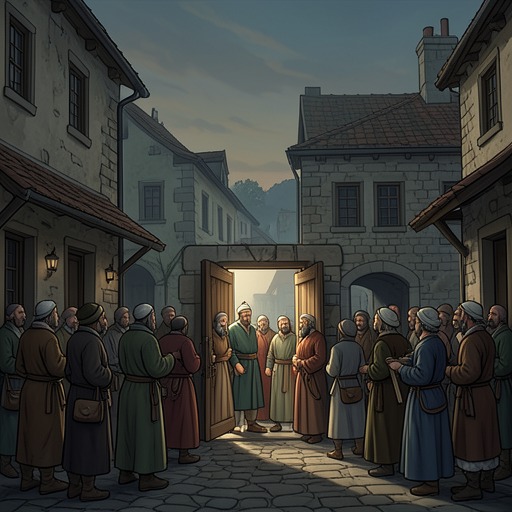
The emigrants gathered at Åkerby Junction. Danjel had hired a team from Kråkesjö for his wife, four children, and Ulrika of Västergöhl. Jonas Petter of Hästebäck drove his own one-horse wagon, with his hired man to take the horse back from Karlshamn. Arvid and Elin, who could not fit on Danjel’s wagon, rode with Jonas Petter. Robert joined them there, sitting beside Elin; he and Arvid, once fellow farmhands at Nybacken, were traveling together after all. Their departure had not followed their earlier fantasy of slipping away alone and secretly on a load of timber.
There were nineteen people at the meeting, but three drivers would return from Karlshamn. The emigrant party itself numbered sixteen: nine adults and seven children. Jonas Petter called them a family of suitable size and raised the question of who would lead it. Karl Oskar declined to assume authority, pointing out that he was the youngest of the three farmers; Jonas Petter was the oldest. The gathering thus made visible how separate decisions had become a shared undertaking, held together by kinship, hired transport, friendship, and the coordination of the route.
From departure to passage
April 4 was the beginning of the journey, not the date the emigrants boarded their ship. The Charlotta sailed from Karlshamn on April 14, bound for New York. It carried seventy-eight emigrants and a crew of fifteen, making ninety-four people aboard, and was already on its seventh voyage as an emigrant ship. The distance between leaving home and setting sail marks the successive thresholds of the migration: the parish road led to the port, and the port to the ocean crossing.
The promised passage also revealed how sharply hope would meet material constraint. In the Charlotta’s hold, canvas divided passengers into compartments for families, unmarried men, and unmarried women. The low, airless space was crowded with bedding, food baskets, and bundles; the passengers had little room to step, and Karl Oskar had to share a two-man bunk with Robert in the unmarried men’s compartment. Each family would receive a weekly allotment of unprepared food and only half a gallon of fresh water per person each day. Passengers had to take turns cooking, clean the hold before receiving water, and obey the ship’s rules. The emigrants had left in search of room and land, but the first stage of their route placed them in confinement and dependence on a tightly regulated vessel.
Significance
The date brings together the novel’s contrast between a settled home that is poor but known and a distant destination that is promising but unseen. The departure is neither a solitary escape nor a fully assured passage: its possibility depends on money sent ahead, available berths, hired wagons, family care left behind, and the willingness of multiple households to travel together. The gates Robert counts and the remembered landmarks of Karl Oskar and Kristina make leaving legible in small, concrete acts. April 4 is therefore both a beginning and a farewell—the moment when a restlessness first carried in rumor becomes movement on the road.